What is ROC?
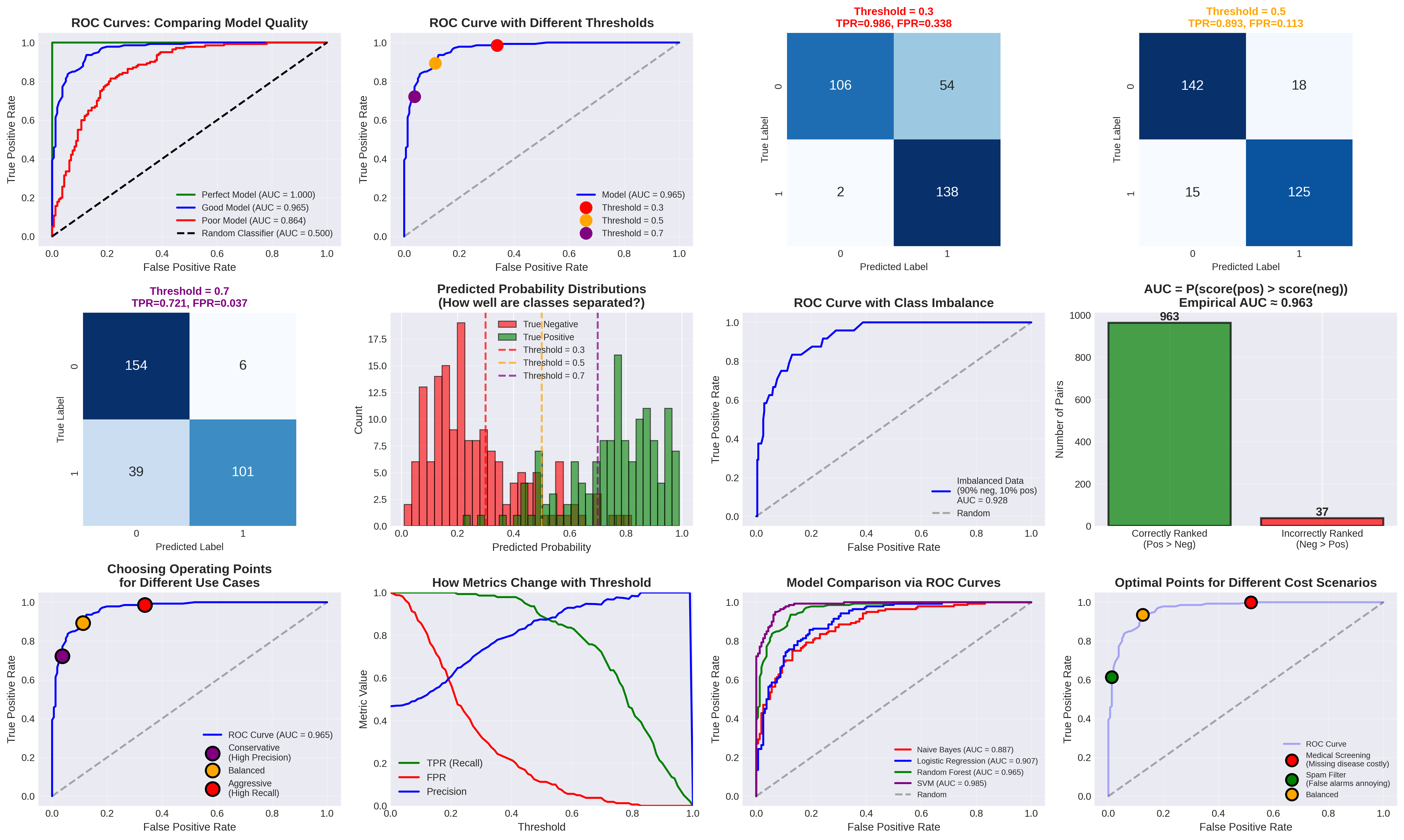
ROC (Receiver Operating Characteristic) visualizes binary classifier performance across ALL possible thresholds by plotting:
- Y-axis: TPR (True Positive Rate) = TP / (TP + FN) ( also called Sensitivity / Recall )
- X-axis: FPR (False Positive Rate) = FP / (FP + TN)
What is AUC?
AUC (Area Under the ROC Curve) is a single number (0 to 1) summarizing model quality:
- AUC = 1.0: Perfect classifier
- AUC = 0.9-1.0: Excellent
- AUC = 0.8-0.9: Very good
- AUC = 0.7-0.8: Good
- AUC = 0.5: Random guessing (useless)
- AUC < 0.5: Worse than random
Intuitive meaning: AUC = probability that model ranks a random positive example higher than a random negative example.
How ROC is Generated
- Model outputs probabilities for each sample
- Generate thresholds (typically every unique probability + ∞ and 0)
- For each threshold:
- Classify: predict 1 if prob ≥ threshold, else 0
- Calculate confusion matrix → get TP, FP, TN, FN (See Precision, Recall and F1 Score)
- Calculate TPR = TP/(TP+FN) and FPR = FP/(FP+TN)
- This gives ONE point (FPR, TPR) on the curve
- Plot all points → connect them → ROC curve!
Key Insights
- Each threshold = one point on ROC curve
- Curve shows trade-offs: Moving threshold changes both TPR and FPR
- Top-left corner = ideal: High TPR, low FPR
- Diagonal line = random: 50% AUC means no predictive power
- Threshold-independent: AUC evaluates ranking ability, not specific threshold
When to Use ROC/AUC
Good for:
- Comparing different models
- Balanced classes or equal importance of both classes
- Threshold-independent evaluation
- Understanding trade-offs between TPR and FPR
Caution:
- Severe class imbalance (consider Precision-Recall curves instead)
- When false positives and false negatives have very different costs
Different use cases need different operating points on the ROC curve:
| Use Case | Priority | Threshold Choice |
|---|---|---|
| Medical screening | High TPR (catch all diseases) | Lower threshold (more aggressive) |
| Spam filter | Low FPR (few false alarms) | Higher threshold (more conservative) |
| Balanced | Equal TPR and FPR importance | Usually ~0.5 |
Sample Example
References
- Fawcett (2006) - An Introduction to ROC Analysis
- Scikit-learn ROC Documentation
- Google ML Course - ROC and AUC
Back to: ML & AI Index