Overview
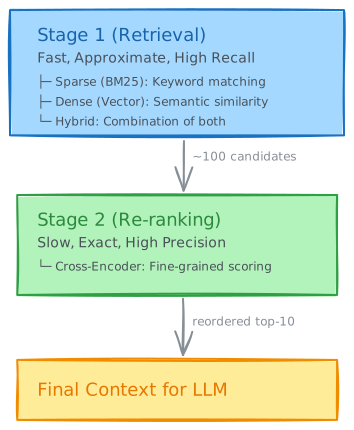
Re-ranking is a post-retrieval refinement step that re-scores and reorders the top-K candidates retrieved by the initial retrieval system. Instead of relying solely on the first retrieval pass (which uses approximate/fast similarity metrics), re-ranking applies a more sophisticated, expensive model to re-evaluate and reorder results for higher precision.
Core Insight: The initial retriever is optimized for recall (finding all potentially relevant documents quickly), often using fast approximate methods. Re-ranking is optimized for precision (finding the most relevant documents from the candidates). This two-stage approach balances speed and accuracy.
Why Re-ranking Matters
From the Advanced Retrieval phase:
- Imperfect Initial Retrieval: Dense retrievers (vector search) and sparse retrievers (BM25) often rank relevant documents below irrelevant ones
- Lost in the Middle: More relevant documents may be ranked 3rd or 4th, while the LLM uses only the top results; re-ranking ensures truly relevant docs appear first
- Noise Reduction: Retrieved results often include false positives; re-ranking filters these out
- Quality Improvement: Using a more sophisticated model for ranking can significantly improve downstream answer quality
The Two-Stage Retrieval Paradigm
Core Concept: Cross-Encoder vs Bi-Encoder
Bi-Encoder - Initial Retrieval
Architecture: Separately encode the query and documents, then compute similarity (usually dot product or cosine).
Query: "How do I fix a bug?"
    ↓ (Encoder 1)
    [vector: 768 dims]
                          Similarity Score
                                  ↑
Document: "Debugging techniques in Python"    [vector: 768 dims] ← (Encoder 2)
Characteristics:
- Compute similarities independently
- Score = similarity(Q_embedding, D_embedding)
- Very fast for retrieval (can pre-compute all document embeddings)
- Works at scale (billions of documents)
- Problem: Ignores inter-token interactions between query and document
Example Models: Sentence-BERT, DPR (Dense Passage Retrieval)
Cross-Encoder - Re-ranking
Architecture: Encode query and document together as input, produce a relevance score.
[CLS] How do I fix a bug? [SEP] Debugging techniques in Python [SEP]
    ↓ (Single Encoder)
    [Multi-head Self-Attention across all tokens]
    ↓
    Relevance Score: 0.92
Characteristics:
- Encode query and document as a single sequence
- Score = relevance(query + document_pair)
- Can attend to interactions between query and document tokens
- Slower (must score each candidate individually; no pre-computation)
- Advantage: Much more accurate relevance assessment
Example Models: BERT-base-uncased fine-tuned for MS MARCO, cross-encoder/mmarco-MiniLMv2-L12-H384-v1
Key Difference in Scoring
Bi-Encoder:
score(q, d) = cos(encode_q(q), encode_d(d))
- Independent encodings → fast but limited interaction
- Query and document don’t influence each other’s representation
Cross-Encoder:
score(q, d) = cross_encode([q, d])
- Joint encoding → slower but rich interaction
- Tokens in document attend to query tokens and vice versa
- Can understand nuanced relevance relationships
Re-ranking Approaches
1. Pointwise Re-ranking (Most Common)
Concept: Score each retrieved document independently to get a relevance probability. How It Works:
Retrieved documents: [doc1, doc2, doc3, ..., docK]
    ↓
Cross-encoder scores each:
  score(q, doc1) = 0.85
  score(q, doc2) = 0.72
  score(q, doc3) = 0.91
  ...
    ↓
Re-rank by score (highest first):
  doc3 (0.91), doc1 (0.85), doc2 (0.72), ...
Strengths:
- Simple and interpretable
- Score = probability of relevance (0-1)
- Easy to filter by threshold (“only include docs with score > 0.7”)
- Works well for most use cases
Best For:
- General Q&A systems
- When interpretable relevance scores needed
- Filtering and thresholding decisions
2. Pairwise Re-ranking
Concept: Score pairs of documents relative to each other, then derive a total order. How It Works:
Compare documents pairwise:
  compare(doc1, doc2) → doc1 is more relevant
  compare(doc1, doc3) → doc3 is more relevant
  compare(doc2, doc3) → doc3 is more relevant
    ↓
Derive total order: doc3 > doc1 > doc2
Strengths:
- Can be more accurate than pointwise (uses comparison information)
- Better at handling ranking tasks where relative order matters most
Limitations:
- Requires pairwise training data (expensive to create)
- Doesn’t provide absolute relevance scores
- O(n²) comparisons for n documents
Best For:
- Large-scale ranking systems (search engines)
- When you need perfect ordering, not just relevance scores
- Systems with access to pairwise training data
3. Hybrid Re-ranking
Combine multiple re-ranking signals (cross-encoder score + BM25 + metadata filters + LLM judgment).
Example:
def hybrid_rerank(query, candidates, cross_encoder, bm25, metadata_filters):
    scores = {}

    for doc in candidates:
        # Score 1: Cross-encoder relevance (0-1)
        ce_score = cross_encoder.score([query, doc]) * 0.6

        # Score 2: BM25 keyword match (normalized to 0-1)
        bm25_score = bm25.score(query, doc) * 0.2

        # Score 3: Metadata match (is it recent, from trusted source, etc.)
        metadata_score = check_metadata(doc) * 0.2

        total_score = ce_score + bm25_score + metadata_score
        scores[doc] = total_score

    reranked = sorted(scores, key=scores.get, reverse=True)
return rerankedStrengths:
- Combines different signal sources
- More robust to individual signal failures
- Can tune weights per use case
- Balance between different relevance aspects
Limitations:
- More complex to implement and maintain
- Weight tuning is tricky (requires data)
- Harder to debug when performance degrades
Best For:
- Production systems with diverse requirements
- Systems with different document types
Integration with the RAG Pipeline
Re-ranking appears at a critical juncture, after initial retrieval but before LLM generation:
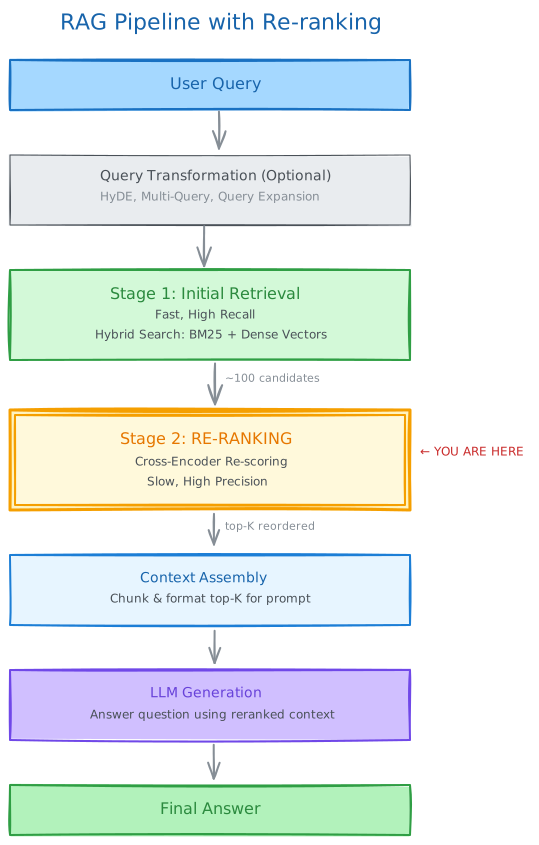
Why This Ordering Matters:
- Query Transformation → Makes query better match document vocabulary
- Initial Retrieval → Casts a wide net, prioritizes recall
- Re-ranking → Filters and reorders for precision (THIS STAGE)
- LLM → Generates using the best documents
Without re-ranking, the LLM works with whatever the retriever found, which may include noise or miss relevant documents ranked 11-100.
Trade-offs & Decision Framework
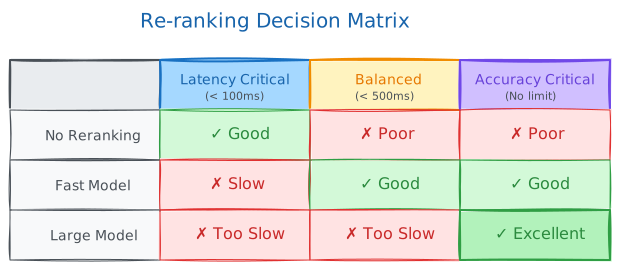
Latency vs Accuracy
No Re-ranking (Fastest):
- Latency: ~50ms (just retrieval)
- Accuracy: Lower (uses fast approximate ranking)
- Use when: Latency is critical (< 100ms)
Fast Re-ranking (e.g., MiniLM):
- Latency: ~200ms (retrieval + rerank ~50 docs)
- Accuracy: Medium-High
- Use when: Balance needed for interactive systems
Slow Re-ranking (Large BERT, LLM):
- Latency: ~1-5 seconds
- Accuracy: Highest
- Use when: Accuracy matters more than latency (offline, batch)
Sample Implementation Patterns
Pattern 1: Basic Cross-Encoder Re-ranking
def rag_retrieval_with_reranking(query, vector_store, cross_encoder, top_k=10):
    # Stage 1: Fast retrieval (recall-oriented)
    initial_results = vector_store.similarity_search(query, top_k=100)

    # Stage 2: Slow re-ranking (precision-oriented)
    pairs = [[query, doc.content] for doc in initial_results]
    scores = cross_encoder.predict(pairs)

    # Stage 3: Reorder
    ranked = sorted(
        zip(initial_results, scores),
        key=lambda x: x[1],
        reverse=True
    )

    # Return top-K after reranking
    return [doc for doc, score in ranked[:top_k]]
Pattern 2: Selective Re-ranking (Cost Optimization)
def selective_rerank(query, vector_store, cross_encoder, threshold=0.7):
    # Retrieve more than needed initially
    candidates = vector_store.similarity_search(query, top_k=50)

    # Rerank only the top candidates (not all 50)
    to_rerank = candidates[:20]  # Rerank only top 20

    pairs = [[query, doc.content] for doc in to_rerank]
    scores = cross_encoder.predict(pairs)

    # Keep originals that weren't reranked, but append reranked ones
    reranked = sorted(zip(to_rerank, scores), key=lambda x: x[1], reverse=True)

    # Filter by threshold
    filtered = [doc for doc, score in reranked if score >= threshold]

    return filtered
Pattern 3: Multi-stage Re-ranking
def multi_stage_rerank(query, vector_store, fast_model, slow_model):
    # Stage 1: Initial retrieval
    candidates = vector_store.similarity_search(query, top_k=100)

    # Stage 2a: Fast re-ranking (filter down to top 20)
    fast_scores = fast_model.predict([[query, doc.content] for doc in candidates])
    fast_ranked = sorted(
        zip(candidates, fast_scores),
        key=lambda x: x[1],
        reverse=True
    )
    top_20 = [doc for doc, score in fast_ranked[:20]]

    # Stage 2b: Slow re-ranking (precise ranking of top 20)
    slow_scores = slow_model.predict([[query, doc.content] for doc in top_20])
    slow_ranked = sorted(
        zip(top_20, slow_scores),
        key=lambda x: x[1],
        reverse=True
    )

    return [doc for doc, score in slow_ranked]
This pattern balances cost and accuracy.
- Only top 20 see the slow model
Evaluation & Metrics
Key Metrics for Re-ranking
NDCG@K (Normalized Discounted Cumulative Gain)
- Measure: How good is the ranking compared to ideal ranking?
- Formula:
- Range: 0-1 (1 is perfect ranking)
- Gold standard for ranking quality
DCG (Discounted Cumulative Gain): Sum of relevance scores, with lower-ranked documents receiving diminishing credit:
Where = relevance score at position .
IDCG (Ideal DCG): The best possible DCG, computed by sorting all documents by relevance (highest first) and calculating DCG on this ideal ordering. Provides the theoretical ceiling for normalization.
MRR@K (Mean Reciprocal Rank):
- Measure: On average, how early is the first relevant result?
- Formula:
MRR = 1/rank_of_first_relevant - Best for: Single-answer scenarios (FAQ, entity lookup)
MAP@K (Mean Average Precision)
- Measure: Precision at each relevant document
- Good for: Evaluating comprehensive answer retrieval
Recall@K:
- Measure: Out of all relevant documents, what % did we retrieve?
- Formula:
relevant_retrieved / total_relevant
Common Pitfalls ( and Potential Solutions )
Over-Relying on Re-ranking
Problem: Using re-ranking to compensate for poor initial retrieval.
- If retrieval gets only 50% recall, re-ranking can’t fix this (can’t rerank what wasn’t retrieved)
Solution:
- First optimize initial retrieval (Hybrid Search, Query Transformations)
- Use re-ranking as refinement, not rescue
Model-Data Mismatch
Problem: Using cross-encoder trained on MS MARCO for medical documents.
- Mismatch between training data and target domain
Solution:
- Fine-tune on domain-specific data if possible
- Use small cross-encoder (faster to fine-tune)
- Fall back to ensemble methods if fine-tuning unavailable
Computational Overhead
Problem: Re-ranking 1000 candidates with large BERT model = 10+ seconds.
- Defeats the purpose of fast retrieval
Solution:
- Multi-stage: Fast model on 100, then slow model on 20
- Batch processing to utilize GPU
- Use lighter models (MiniLM, TinyBERT)
- Selective re-ranking: only rerank top-K from initial retrieval
Score Mis-calibration
Problem: Cross-encoder outputs [0.92, 0.78, 0.45] but you don’t know what these mean absolutely (just relative).
- Can’t use raw scores for filtering/thresholding
Solution:
- Use models trained with proper calibration (temperature scaling)
- Don’t rely on absolute score values; use relative ranking
- Test thresholds empirically on your data
Comparison with Alternatives
Latency numbers are an estimation here (obviously) just the provide a vague idea.
| Approach | Latency* | Accuracy | Complexity | Cost | Best For |
|---|---|---|---|---|---|
| No Re-ranking | 50ms | Low | 0 | $0 | Real-time, low stakes |
| Cross-Encoder (Fast) | 200ms | Medium | 1 | Low | Balanced systems |
| Cross-Encoder (Large) | 1-2s | High | 1 | Medium | Accuracy-critical |
| LLM Re-ranking | 2-5s | Very High | 2 | High | Complex relevance |
| Hybrid | 300-500ms | High | 3 | Medium | Production systems |
| Learning-to-Rank | 100-300ms | Very High | 4 | High | Search engines |
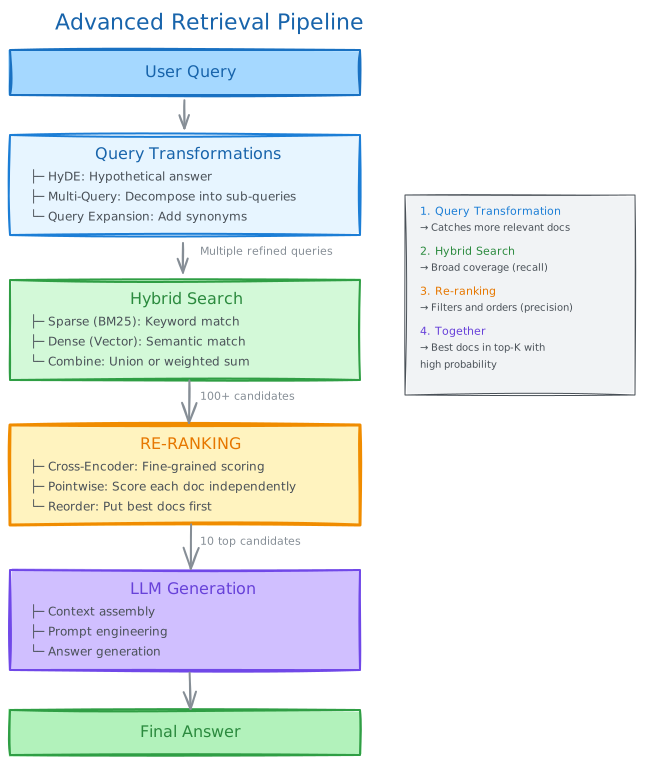
Integration with Query Transformations and Hybrid Search
See Also
- Advanced Retrieval Phase - Where re-ranking fits in
- Hybrid Search - Initial retrieval stage before re-ranking
- Query Transformations - Query preprocessing (before retrieval)
- RAG Evaluation Metrics - Measuring re-ranking impact on pipeline quality