Overview
Hybrid Search is the gold standard for production RAG systems. It combines two fundamentally different retrieval approaches:
- Sparse (Lexical): Fast, exact keyword matching (e.g., BM25)
- Dense (Semantic): Neural embeddings that understand meaning and concepts
By running both methods and fusing their results, Hybrid Search achieves superior recall and relevance compared to using either method alone.
Why it matters: Most real-world applications benefit from this approach. Research shows Hybrid Search consistently outperforms single-method approaches in production scenarios.
The Vocabulary Mismatch Problem (The Core Issue)
Hybrid Search exists to solve a fundamental problem in information retrieval:
Problem 1: Sparse-Only Limitation
Synonym/Paraphrase Mismatch
- Query: “car”
- Relevant document: “Find an affordable automobile”
- Result: Missed! BM25 only matches exact keywords.
Why it matters: Users don’t always use the exact terminology as the documents. A technical support bot searching for “fix the printer” shouldn’t miss documents about “troubleshooting devices” or “resolving hardware issues.”
Problem 2: Dense-Only Limitation
Domain-Specific Terms & Proper Nouns
- Query: “XJ-900 specifications”
- Document A: “The XJ-900 is our flagship product…”
- Document B: “This generic vehicle part is commonly used…”
- Result: Dense models struggle. They’re trained on general text, not technical specifications or product codes.
Why it matters: In specialized domains (legal, medical, engineering), exact terminology is critical. A general embedding model may not understand that “ICD-10-CM” is more important than words like “the” or “and”.
The Hybrid Solution
Combine both strengths:
- BM25 catches exact matches: “XJ-900”, “ICD-10-CM”, “SQL injection”, etc.
- Dense catches concepts: “broken” ↔ “malfunctioning”, “vehicle” ↔ “car”, etc.
- Together: Complete coverage across vocabulary variations AND semantic understanding
How Hybrid Search Works (High-Level Flow)
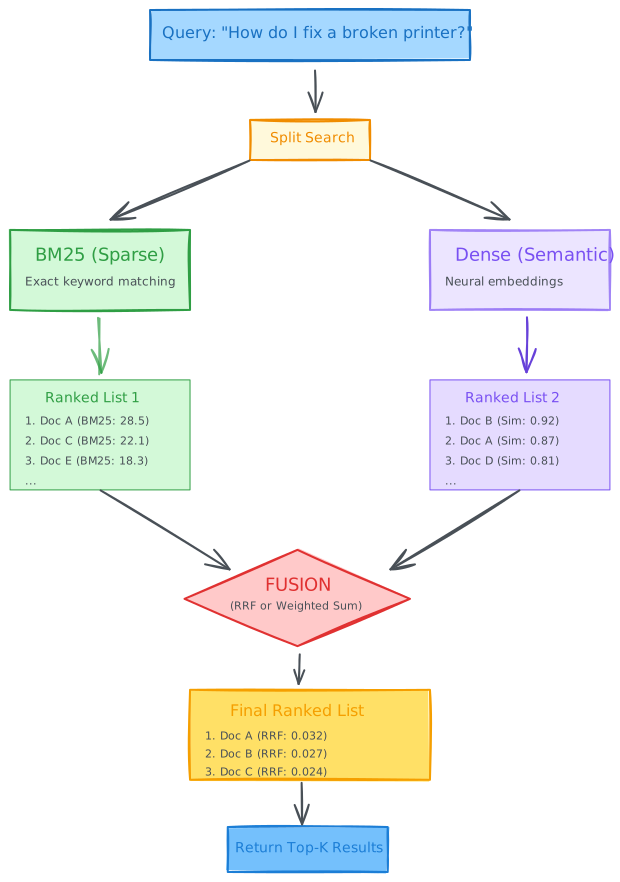
The Two Pillars
1. Sparse Retrieval (Lexical)
Method: Inverted Index + BM25 scoring (or TF-IDF)
How it works:
- Builds an inverted index:
word → list of documents containing that word - When you search, it finds all documents with exact keyword matches
- Ranks them using BM25 score (see BM25 for detailed formula)
Characteristics:
| Aspect | Details |
|---|---|
| Speed | Very fast (simple index lookup) |
| Index Size | Small (just the inverted index) |
| Memory | Low (no neural models needed) |
| Training | None needed (works immediately) |
| Strengths | Exact matches, acronyms, proper nouns, product codes |
| Weaknesses | Misses synonyms and paraphrases |
Examples of what it excels at:
- Product ID searches: “SKU-12345-A”
- Acronyms: “XML”, “API”, “RAG”
- Named entities: “Microsoft”, “COVID-19”
- Technical jargon: “ACID compliance”, “normalization”
2. Dense Retrieval (Semantic)
Method: Bi-Encoders with neural embeddings (e.g., OpenAI text-embedding-3, Hugging Face BGE-M3)
How it works:
- Pre-trained neural network encodes text to dense vector (typically 384-1536 dimensions)
- Similarity = cosine distance between query vector and document vector
- Higher similarity = more semantically related
Characteristics:
| Aspect | Details |
|---|---|
| Speed | Fast (vector similarity is fast) |
| Index Size | Small (vectors are compact) |
| Memory | Medium (need to store model, indices) |
| Training | Pre-trained; can be fine-tuned for your domain |
| Strengths | Synonyms, paraphrases, cross-lingual, conceptual matching |
| Weaknesses | Domain shift (poor on unseen domains), struggles with exact tokens |
Examples of what it excels at:
- Paraphrases: “fix a flat” ↔ “tire repair”
- Synonyms: “automobile” ↔ “vehicle” ↔ “car”
- Intent matching: “how to learn Python” ↔ “Python tutorials”
- Cross-lingual (would require multilingual embedding model): “Hello” ↔ “Hola” ↔ “你好”
- Concept drift: “broken car” ↔ “malfunctioning vehicle”
Sparse vs Dense: Side-by-Side Comparison
| Query | Document | BM25 | Dense | Verdict |
|---|---|---|---|---|
| ”Python tutorial" | "Learn Python programming” | Perfect match | Perfect match | Both find it |
| ”How to fix a flat" | "Tire repair instructions” | No keyword overlap | Semantic match | Dense wins |
| ”GPU performance" | "Graphics Processing Unit speed" | "GPU” ≠ “Graphics Processing Unit” | Some match | BM25 wins |
| ”XJ-900 specs" | "The XJ-900 is a…” | Exact match | May miss (unfamiliar token) | BM25 wins |
| ”vehicle" | "types of cars and trucks” | No exact match | Semantic match | Dense wins |
Observation: Each method misses cases the other catches. Hybrid Search combines them to avoid missing anything.
Fusion Strategies
The core challenge: How do you combine results from two completely different scoring systems?
- BM25 scores: Range 0–40+ (unbounded, sparse)
- Dense scores: Range 0.0–1.0 (normalized, dense)
Strategy 1: Weighted Sum
Normalize both scores to 0-1 range, then take a weighted average.
- = weight for dense (0.0 to 1.0)
- = min-max normalization to [0, 1]
- = weight for sparse
Pros:
- Intuitive (literally averaging the methods)
- Direct control over trade-off (tune α)
- Can give different weights to sparse vs dense
Cons:
- Requires score normalization (adds complexity)
- Sensitive to score distribution (changes per query type)
- Requires tuning α for your use case
- May need different α values for different domains
When to use:
- You have domain knowledge and want explicit control
- You can evaluate and tune α on your test set
- One method consistently outperforms the other in your domain
Strategy 2: Reciprocal Rank Fusion (RRF) - Recommended
Don’t use scores at all. Just use the rank (position) of each document in each retriever’s result list.
Where:
- = smoothing constant (usually 60)
- = position of doc in retriever ‘s list (1st place = 1, 2nd place = 2, etc.)
Intuition:
- Being #1 in both lists = exponentially boosted
- Being #1 in one list, #50 in other = good (compound evidence)
- Being #100 in both lists = nearly irrelevant (too far down)
Pros:
- No score normalization needed
- Robust across all query types
- No hyperparameter to tune (k=60 is standard)
- Industry standard (widely used in production)
- Handles score distribution differences automatically
- Simple to implement
Cons:
- Loses granular score information
- Less flexible if you want explicit weighting
- Less interpretable than weighted sum
When to use:
- Default choice for most production systems
- You don’t have a validated test set to tune α
- You want robustness across diverse query types
- You want simplicity and reliability
Why it works so well: RRF is theoretically sound (proven in information retrieval), practically simple, and empirically excellent. It’s the industry standard because it “just works” across most scenarios without tuning.
Comparison: Weighted Sum vs RRF
| Factor | Weighted Sum | RRF |
|---|---|---|
| Tuning | Requires α tuning | None (k=60 fixed) |
| Score normalization | Required | Not needed |
| Complexity | Medium | Simple |
| Robustness | Good (if α tuned) | Excellent (adaptive) |
| Production readiness | Good | Best |
| Interpretability | High (explicit weights) | Medium (rank-based) |
| When it shines | Domain-specific optimization | General-purpose / unknown domains |
Bottom line: Start with RRF. Use Weighted Sum only if you can validate α on your data.
Decision Guide: When to Use What
| Scenario | Best Choice | Why | Notes |
|---|---|---|---|
| Legal/Medical Documents | Hybrid | Domain-specific terminology (“tort”, “ICD-10-CM”, “tort law”) is critical. Dense alone may miss exact terms | Use Hybrid with RRF |
| General Knowledge (Wikipedia) | Hybrid | Mix of exact terms + synonyms | Perfect use case for Hybrid |
| E-commerce Product Search | Hybrid | Need both SKU matches (sparse) + semantic understanding (dense) | Higher α for exact part numbers |
| Real-time Constraints (<100ms) | BM25 | Dense inference adds 50-200ms latency | Trade-off: less accuracy for speed |
| Very Small Dataset (<1000 docs) | Dense | BM25 overkill; Dense simpler to set up | Can use dense only |
| Very Large Dataset (>10M docs) | Hybrid | BM25 filters to top-1000, Dense reranks (two-stage) | Cost-efficient & accurate |
| Multilingual Search | Dense | Semantic models naturally handle cross-lingual | Can be Dense only |
| Domain Shift Expected | Hybrid | Dense weakens on new domains; BM25 is safety net | Critical for robustness |
| Private/Sensitive Data | Hybrid (BM25-heavy) | Dense requires external embeddings API | Use local embedding models or BM25 |
| Unknown Domain (Cold Start) | Hybrid | Most robust; handles any scenario | Default choice when unsure |
Practical Implementation Patterns
Pattern 1: Two-Stage Hybrid (Recommended for Scale)
Stage 1: BM25 retrieves top-1000 candidates (fast filter)
Stage 2: Dense reranks top-1000 (high quality)
Result: RRF fusion of both

Benefits: Speed + Quality
Pattern 2: Parallel Hybrid (Simplest)
Run BM25 and Dense in parallel
Fuse results immediately
Return top-k

Benefits: Simplicity
Pattern 3: Weighted Hybrid (Domain Optimized)
Run both in parallel
Weighted sum fusion (tuned α)
Return top-k

Benefits: Domain-specific optimization
Benefits of Hybrid Search
Completeness
- No missed results: Complementary strengths ensure high recall
- Safety net: If one method fails, the other catches it
Robustness
- Domain invariant: Works across any domain
- Query invariant: Handles varied query styles
- Degrades gracefully: If dense embeddings are weak, BM25 compensates
Practical
- No tuning required (with RRF): Works out-of-the-box
- Interpretable: Can see which method found what
- Proven: Used by Google, Pinecone, Elasticsearch, etc.
Performance Metrics to Track
When evaluating Hybrid Search, measure:
| Metric | What it measures | Target |
|---|---|---|
| Recall@k | ”Did we find the right doc in top-k?” | Higher is better |
| NDCG@k | ”How well-ranked are the results?” | Higher is better |
| MRR | ”How high is the first correct result?” | Higher is better |
| Latency | ”How fast is retrieval?” | <100ms for interactive |
| Cost | ”Embedding API calls, index size” | Lower is better |
Advanced Architectures (Beyond Basic Hybrid)
These approaches try to solve limitations of basic Hybrid Search:
1. SPLADE (Sparse Lexical and Expansion)
What if we could make sparse retrieval smarter?
Concept: Learned Sparse Vectors that combine the interpretability of sparse search with the synonym-matching of dense search.
How it works:
- Uses a BERT model to learn which terms to expand a query with
- Outputs sparse vectors (non-zero values for relevant terms only)
- Uses inverted index just like BM25 (fast!)
Example:
- Input query: “car”
- Traditional sparse: Matches only docs with “car”
- SPLADE: Learns to expand with synonyms
- Output:
{"car": 1.0, "vehicle": 0.85, "automobile": 0.7, "motor": 0.65} - Result: Docs with “vehicle” are found even though they don’t have “car”!
Pros:
- Combines sparse efficiency with semantic understanding
- Interpretable (can see which terms matched)
Cons:
- Requires SPLADE-specific indexing (not all databases support it)
- Less mature than basic Hybrid
- Training required
When to use: When you want semantic understanding WITHOUT the index overhead of dense vectors. Cutting-edge, not yet mainstream.
2. ColBERT (Late Interaction)
What if we stored vectors for every token?
Concept: Hybrid between bi-encoders (compress doc to 1 vector) and cross-encoders (full interaction).
How it works:
- Encode document at token-level (not doc-level)
- Store a vector for every token in the document
- At query time, compute MaxSim: max similarity between each query token and document tokens
- Sum MaxSim scores for final ranking
Example:
Query tokens: ["best", "AI", "paper"]

Doc: "This is the best AI research paper ever"
Doc tokens: [T1, T2, T3, T4, T5, T6, T7, T8]

For query token "best":     MaxSim = max(sim(best, T1), ..., sim(best, T8))
                            = sim(best, T4) = 0.99 (perfect match with T4="best")

For query token "AI":       MaxSim = max(sim(AI, T1), ..., sim(AI, T8))
                            = sim(AI, T5) = 0.98 (perfect match with T5="AI")

For query token "paper":    MaxSim = max(sim(paper, T1), ..., sim(paper, T8))
                            = sim(paper, T7) = 0.97 (perfect match with T7="paper")

Overall score: 0.99 + 0.98 + 0.97 = 2.94 (very high!)
Pros:
- SOTA accuracy
- Fine-grained token-level matching
- Handles phrase matching naturally
Cons:
- Index size ~100x larger (vectors for every token!)
- Slower inference (more computation)
- Higher cost (storage + compute)
When to use: When accuracy is critical and budget permits (legal discovery, financial research, high-stakes applications). Not for real-time / cost-sensitive scenarios.
3. Understanding Domain Shift (Why Hybrid is Essential)
The Problem: Dense embedding models are trained on general-purpose data:
- OpenAI embeddings: Trained on diverse internet text
- BGE-M3: Trained on web search & Wikipedia-like data
When you move to a specialized domain, accuracy often drops sharply.
Real Examples:
- Medical: “acute” = precise clinical term (not just “sharp”)
- Legal: “consideration” = legal concept (not just “thinking about something”)
- Finance: “yield” = investment return (not just “to give way”)
Why this happens:
- Embedding model never learned domain-specific semantics
- Vector space doesn’t distinguish domain-specific terms from generic ones
Example Failure:
Domain: Medical
Query: "acute myocardial infarction treatment"

Dense model (confused):
- "acute" is just "sharp" or "severe"
- "myocardial infarction" is unfamiliar tokens
- Returns generic medical articles instead of specific MI treatment docs

BM25 (works fine):
- "acute", "myocardial", "infarction", "treatment" = exact matches
- Returns relevant docs despite not understanding domain semantics
The Solution: Hybrid Search + RRF ensures that even if dense fails, BM25 catches you. In domain-specific scenarios, BM25 often contributes 40-60% of the final ranking!
Mitigation strategies:
- Use Hybrid Search with RRF (primary)
- Fine-tune embedding model on domain data (if possible)
- Use domain-specific embedding model (e.g., BioBERT for medical)
- Increase BM25 weight (use Weighted Sum with α < 0.5)
Example Comparison Matrix
| Feature | BM25 | Dense | Hybrid (RRF) | SPLADE | ColBERT |
|---|---|---|---|---|---|
| Recall@10 | ~60% | ~75% | ~85% | ~80% | ~90% |
| Latency | 5ms | 50ms | ~55ms | 5ms | 100ms |
| Index Size | 100MB | 500MB | 600MB | 200MB | 5GB |
| Training Needed | No | Pre-trained | No | Yes | Pre-trained |
| Domain Shift | Robust | Weak | Robust | Robust | Robust |
| Exact Match | Excellent | Poor | Excellent | Excellent | Excellent |
| Synonym Match | Poor | Excellent | Excellent | Excellent | Excellent |
| Production Ready | Yes | Yes | Yes | Emerging | Expensive |
| Setup Complexity | Simple | Medium | Medium | Hard | Hard |
| Cost to Run | Low | Medium | Medium-High | Medium | High |
Hybrid (RRF) provides the best balance of recall, robustness, and simplicity for most use cases.
Checklist for Implementation
Before building Hybrid Search, ensure you have:
- Documents: Indexed and ready
- Vector Database: Set up (Pinecone, Weaviate, Milvus, etc.)
- Embedding Model: Chosen (OpenAI, Hugging Face, etc.)
- BM25 Index: Built (Elasticsearch, Lucene, etc.)
- Fusion Strategy: (RRF recommended)
- Test Set: Created for evaluation
- Metrics: (Recall@k, NDCG@k, MRR)
- Baseline: BM25-only results (to compare against)
FAQ
Q: Will Hybrid Search slow down my search?
A: Slightly. RRF adds ~10-20ms overhead (two parallel retrievals). Still <100ms total, acceptable for most applications.
Q: Do I need to tune anything?
A: With RRF, no tuning required. With Weighted Sum, you need to tune α.
Q: What if I can’t store dense vectors due to space?
A: Try SPLADE (learned sparse representations) or use BM25 + re-ranking instead.
Q: Do I need to fine-tune embeddings?
A: Only if you’re in a specialized domain and have labeled data. For most cases, pre-trained embeddings are fine.
Resources & References
Foundational Papers
- Reciprocal Rank Fusion
- BM25
- SPLADE: Sparse Lexical and Expansion Model (Formal et al., 2021)
- ColBERT: Efficient and Effective Passage Search (Khattab & Zaharia, 2020)
Others
- Pinecone: Hybrid Search:
- Pinecone: Managed vector database with hybrid search
- Milvus: Open-source vector database
- Weaviate: Vector database with built-in hybrid
Back to: 01 - RAG Index